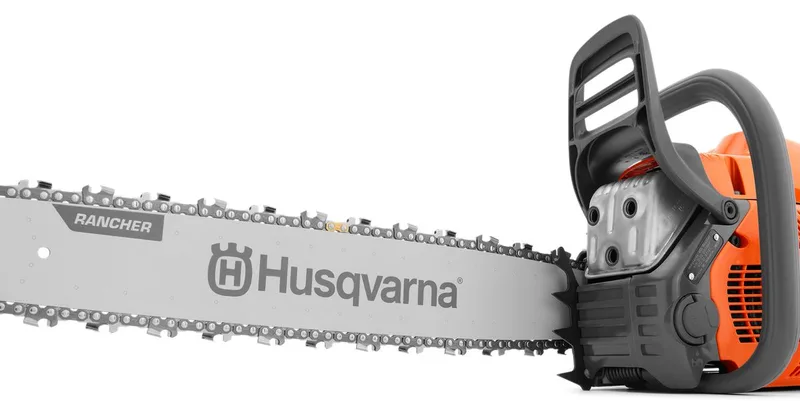
Husqvarna 455 Rancher
Designed for property owners and ranch operators who demand reliable power for medium to heavy-duty cutting tasks, this Swedish-engineered chainsaw combines robust performance with user-friendly operation. Its 55.5cc two-stroke engine delivers 3.5 horsepower at 2.61 kW, providing ample power for felling medium-sized trees, limbing, and firewood cutting.
Building on Husqvarna's decades of chainsaw expertise since 1959, this Rancher series model accommodates bar lengths up to 61cm while maintaining a manageable 5.99kg weight without bar and chain. The saw operates at speeds up to 9,000 rpm with a chain speed of 20 m/s, making it efficient for varied cutting applications. With its 0.33-liter oil tank and 50:1 fuel mixture requirement, it offers practical runtime for extended work sessions while maintaining the durability expected from professional-grade outdoor power equipment.
Technical Specifications
Alternatives →| Engine Displacement | 55.5 cc |
| Power Output | 2.61 kW |
| Power Output (HP) | 3.5 hp |
| Idle Speed | 2700 rpm |
| Maximum Speed | 9000 rpm |
| Recommended Bar Length | 50 cm |
| Maximum Bar Length | 61 cm |
| Chain Pitch | 3/8 " |
| Chain Speed | 20 m/s |
| Weight (without bar and chain) | 5.99 kg |
| Oil Tank Capacity | 0.33 l |
| Sound Pressure Level | 107 dB(A) |
| Sound Power Level | 115 dB(A) |
| Vibration Front Handle | 3.8 m/s² |
| Vibration Rear Handle | 6.9 m/s² |
| Intended Use | Rancher Series |
| Fuel Type | Husqvarna 2 stroke or equiv. at 50:1 |
Frequently asked questions
What is the Husqvarna 455 Rancher best suited for?
The Husqvarna 455 Rancher is a Rancher Series petrol saw built around a 55.5 cc engine rated at 2.61 kW, or 3.5 hp. That output, paired with a recommended 50 cm bar, suits felling medium trees, limbing and cutting firewood on a smallholding rather than occasional light pruning around a garden.
What bar length can the Husqvarna 455 Rancher run?
Husqvarna lists a recommended bar length of 50 cm for the 455 Rancher and a maximum of 61 cm. The 50 cm setup keeps the saw balanced for everyday cutting, while the 61 cm bar extends reach for larger trunks at the cost of a heavier, slower-handling front end.
How much does the Husqvarna 455 Rancher weigh?
The Husqvarna 455 Rancher weighs 5.99 kg without bar and chain. That figure excludes the 50 cm bar, the chain, the fuel and the 0.33 litre oil charge, so the saw in your hands is noticeably heavier. At roughly 6 kg dry it is a two-handed saw meant for ground work, not overhead pruning.
What chain does the Husqvarna 455 Rancher use and how fast does it run?
The Husqvarna 455 Rancher runs a 3/8 inch pitch chain at 20 m/s, with the engine idling at 2,700 rpm and topping out at 9,000 rpm. The 3/8 inch pitch is the common heavier-duty size, so replacement chains are easy to source, and 20 m/s moves plenty of wood per pass.
How loud is the Husqvarna 455 Rancher and how much does it vibrate?
The Husqvarna 455 Rancher is rated at 107 dB(A) sound pressure at the operator's ear and 115 dB(A) sound power, so ear defenders are not optional. Vibration is measured at 3.8 m/s² on the front handle and 6.9 m/s² on the rear, the rear grip being the one that limits comfortable run time.
What fuel does the Husqvarna 455 Rancher need?
The Husqvarna 455 Rancher runs on petrol mixed with Husqvarna two-stroke oil, or an equivalent, at 50:1. Chain lubrication is separate: a 0.33 litre tank feeds oil to the bar. Refill that oil tank every time you refuel, because running the 50 cm bar dry wears the chain and bar quickly.
See alternatives to the Husqvarna 455 Rancher →
Guides that cover this model
Source: www.husqvarna.com